

Why do I feel compelled to write this blog? Surely most of my students already know the benefits of Iyengar yoga? Well, yes, hopefully!
But I feel that it’s time to share the message, and to spell out why I believe that this yoga method is truly the best way to experience the fullness of yoga – for everybody.
The Use of Props
The most obvious difference between Iyengar yoga and other forms of yoga is the creative use of props. BKS Iyengar pioneered their use as a sickly child who was introduced to yoga by his less-than-accommodating uncle, Tirumalai Krishnamacharya. Starting at first with adapting what he could find around the house, he used sawn-off bits of wood as bricks and so on.
The use of props isn’t to make yoga ‘easier’. In fact, it can often make it harder! Props are there to act as limb extensions in order to touch the floor in Uttanasana (Standing forward fold), or to bring awareness to certain parts of the body in a pose, such as this week when we were holding a brick to the breastbone to bring awareness and openness there. Props can make parts of the body work harder, such as using a belt on the thighs to turn them in standing poses. The wall and the floor both count as props in Iyengar yoga and can help to understand balancing poses with support.
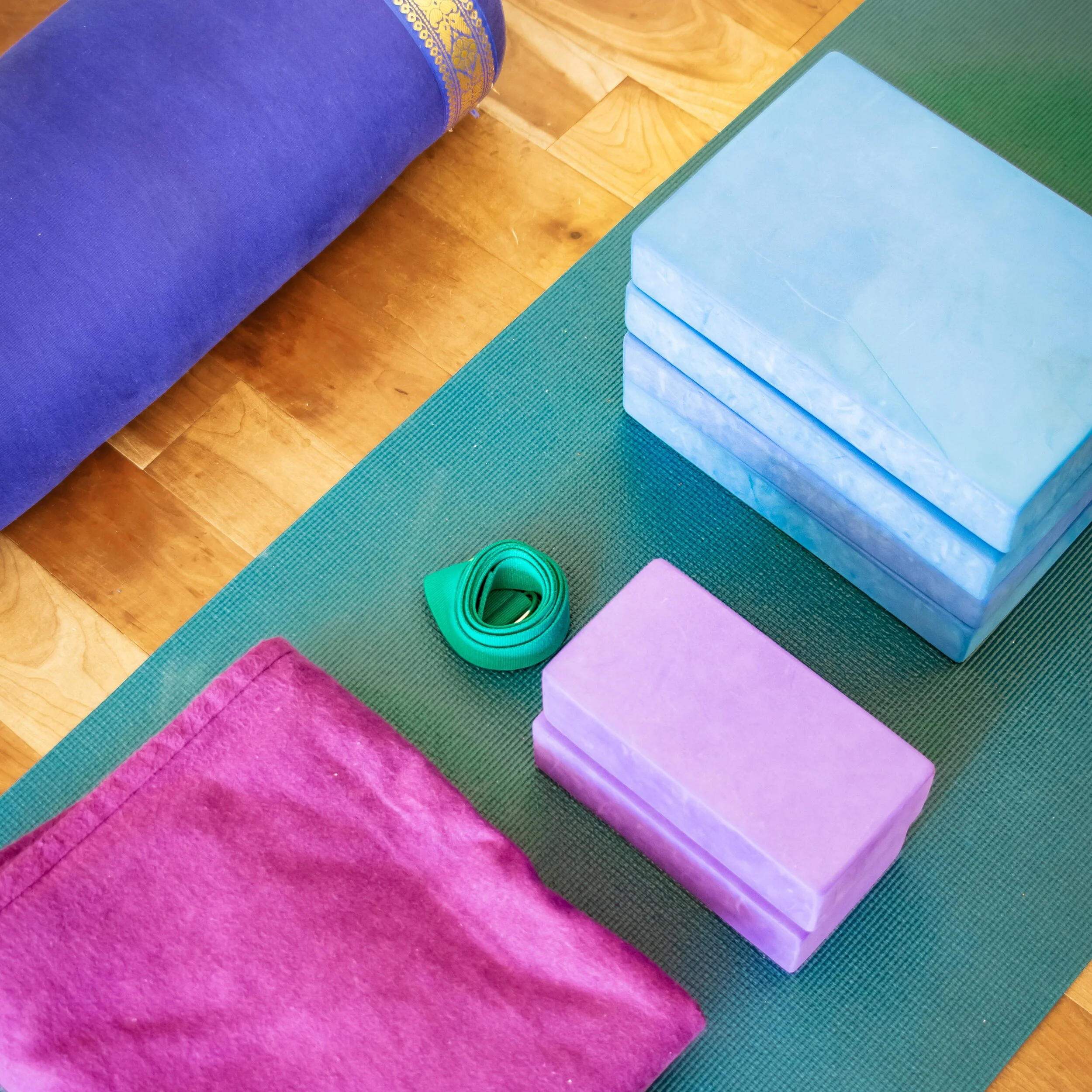
Props are also essential for restorative yoga, which I teach regularly. The use of bolsters and blankets allows the body to find rest in a world that is constantly stretching our nervous systems to the max.
The Use of Demonstration and Correction
In an Iyengar yoga class, you will have plenty of opportunities to fully understand the pose you’re being asked to do. Firstly, the teacher will demonstrate the full pose, showing what props will be used. Then the teacher will often do the first side of the pose with the class, as a reminder, giving detailed verbal instructions at the same time.
Then the teachers will leave their mats and OBSERVE the students, to give detailed corrections and occasionally physical corrections. No student is left to flounder at the back on their own.
The Training
Iyengar yoga teachers are extremely well-trained. The training is mentor-led, with students needing to attend regular classes for a minimum of three years before a three-year training period. At the moment I’m studying for the next Level of teaching and have been for the last five years. There is no time limit on the training time, and my mentor and ‘mentee’ decide together when they are ready for assessment.
This means that learning is done in an organic way. The necessary skills are not just rote-learned but acquired through years of observation and practice.
The Lineage
Most Iyengar yoga teachers start their classes with the invocation to Patanjali. This isn’t just to challenge their students with chanting another language (Sanskrit, the basis of all Indo-European languages), but because Iyengar yoga is based on the yoga sutras of Patanjali, a sage, the likes of Leonardo da Vinci, who lived about 1700 years ago.
Patanjali’s sutras were interpreted and studied by BKS Iyengar, who used them as the philosophical basis of this methodology. The Iyengar family are still the head and heart of the global Iyengar yoga community. BKS Iyengar’s granddaughter Abhijata took over when her grandfather and aunt, Geeta, died within a few years of each other. She has led the yoga community through the Covid pandemic and has also implemented seismic changes to the training systems to be more compassionate to trainee teachers. Her teaching style is clear, challenging, but also puts emphasis on the intelligence of the practitioner. Teachers are encouraged to apply to study for month-long blocks at the Institute of Iyengar yoga in Pune in India, giving teachers an authentic grounding.
The IY(UK) is the UK’s national association and formal link to Pune. They organise national conventions with visiting teachers from India, have a database of all Iyengar yoga teachers in the UK and Northern Ireland, and regulate and assess all teachers. But you don’t have to be a teacher to be a member. As a member of IY(UK) you receive a high-quality, packed biannual magazine, as well as lots of extra benefits.
The Sequencing
Iyengar yoga is a progressive system. Students will be guided from the basic poses (which are never really ‘basic’) to more advanced poses as and when they are ready. There are always options offered for trickier poses, so students aren’t just left twiddling their thumbs.
Many Iyengar yoga teachers use what’s known as ‘the Pune cycle’ which is a four-weekly rotation of standing poses, forward bends, backbends and pranayama (and restorative yoga). This isn’t a set system but is a useful framework to make sure students cover all the different types of poses on a regular basis. I have adapted this to a five-week cycle to include twists and miscellaneous (such as abdominal poses).
There are no set sequences in Iyengar yoga, and you will never attend the same class twice. The most experienced teachers can craft sequences which guide students to poses you didn’t think you were capable of or can use one pose to highlight a certain aspect of another pose. Everything is taken into account – the level of students, the location, the props available, the time of year, the time of day. When you attend an Iyengar yoga class, it’s finely tuned. An Iyengar yoga teacher can also be adaptable and change their lesson plan if needed.
This sequencing includes pranayama, the third limb of yoga, a powerful practice which increases the capacity of the breath and soothes and restores the nervous system.
The Suitability for those with Injuries and Issues
All Iyengar yoga teachers are trained to deal with common injuries and issues, such as pulled muscles, stiff lower back, tight hips and so on. We are NOT doctors and will always defer to medical experts, but once a student is considered fit to return to exercise, Iyengar yoga has the tools to rehabilitate and strengthen the body. Restorative yoga is also an incredible resource for all of us, but especially for those who face physical or mental challenges in their day to day lives.
For more complex injuries and illnesses there are qualified therapy teachers who study for years and can work one to one with students.
The Support
I found Iyengar yoga 15 years ago, happening by chance across it once my youngest started nursery. From my first class on the sticky floor of a local pub I was hooked. Not only was my body stretched in new and intriguing ways, but my mind was stretched too.
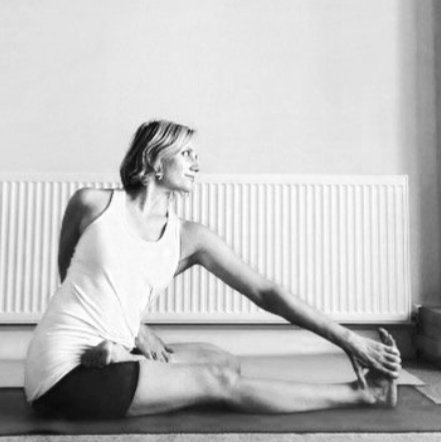
I’ve now been a teacher for eight years, and some of those years have been the hardest of my life so far, coping with family illness and bereavement. The combination of my practice, my teaching and the support of my Iyengar yoga teaching community has got me through those years.
As BKS Iyengar writes in his illuminating book Light on Life,
“Asana practice is an opportunity to look at obstacles in practice and life and discover how we can cope with them.”
Attending a weekly yoga class might not seem like much, but that commitment, to yourself, to your teacher and to your fellow students creates a community that has the power to lift and support you.