
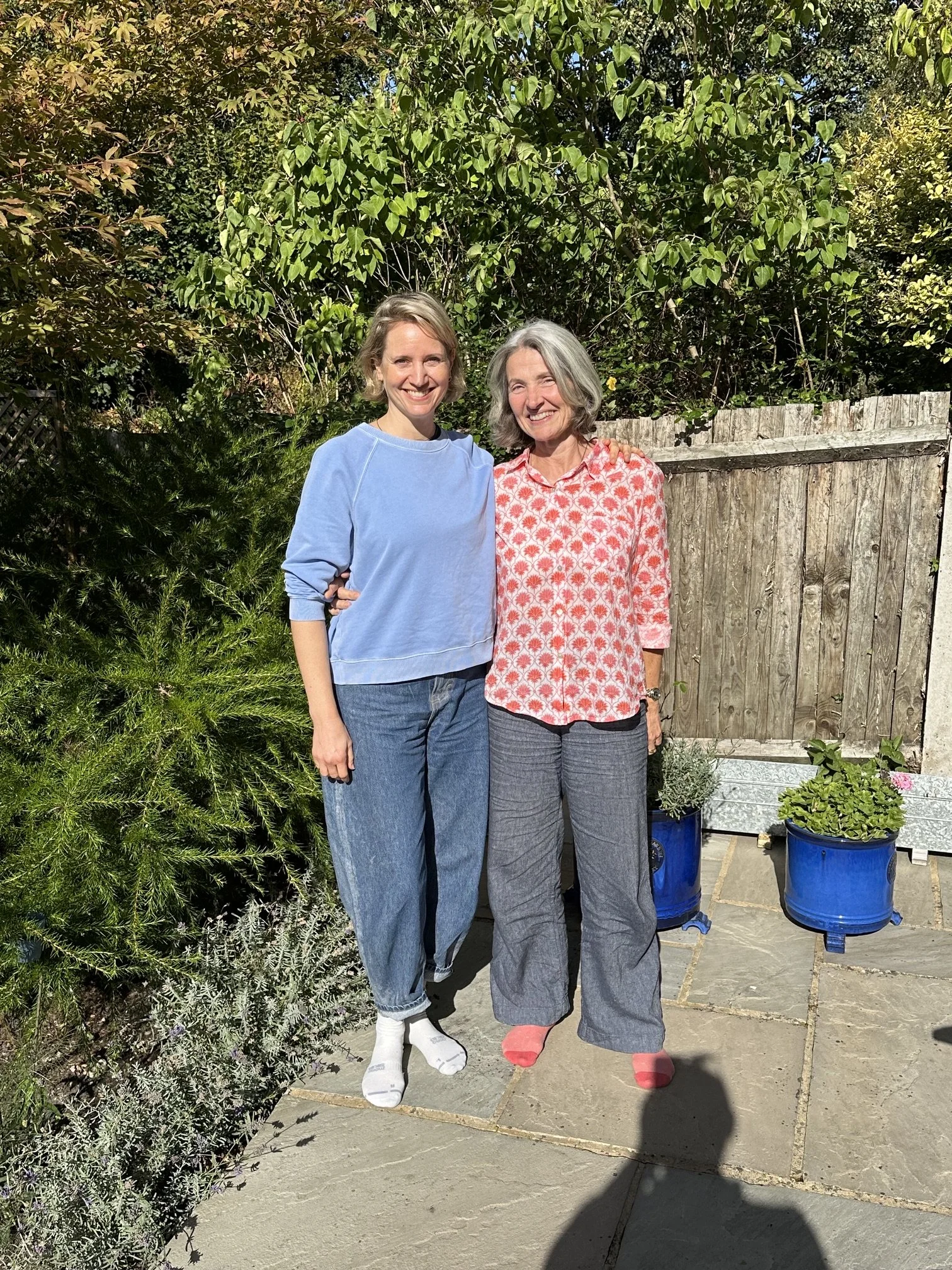
My mentor Cecilia Winter and I in her garden after I found out I’d passed.
Over five years of committed training, practice, assignment writing and teaching practice was coming together, as I rang on the doorbell of my mentor’s house on a bright Saturday morning in September.
The assessment was finally here. My mentor and I had agreed that I was ready for assessment back in February and the seven months wait meant that I now felt more than ready for what lay ahead.
Iyengar yoga ‘Levels’
In order to understand the gravitas of this moment, I’m going to fill you in on the Iyengar yoga teaching hierarchy, which underwent a seismic shift in 2020. When I qualified in 2017 there were many rungs on the ladder to becoming a senior teacher. You passed your Introductory assessment, which qualified you to teach. There were then three Junior Intermediate levels, three Senior levels, three Junior Advanced levels and then finally (and virtually unattainable to all but a few) two levels of the Senior Advanced status.
Abhijata Iyengar, BKS Iyengar’s granddaughter, and the current matriarch of the global Iyengar yoga community, decided that this system should be simplified, and there is now Level 1, Level 2, Level 3, Level 4 and Level 5 (I don’t know of any teachers who are Level 5). This means that 12 assessments have been simplified down to five, making each level much harder…and a much bigger jump, not only in terms of the poses that need to be mastered, but also the level of teaching required.
The Mentor system
At the same time Abhijata decreed that the current teacher training system should be replaced by a mentor system. Anyone wishing to become an Iyengar yoga teacher, or further their teaching status, needs to find a mentor at least one Level higher than them. The mentor is then responsible for ensuring that the trainee (or mentee if you’re going for higher teaching levels) is working to the standard required before being put forward for assessment. This makes it a more individual approach, as each person will need a different length of time for the rigorous preparation.
My Level 2 Journey
I have been lucky enough to have two brilliant mentors on my Level 2 journey. I started out with my teacher of around ten years, Wendy Mcguire. I started attending regular Level 2 workshops with her around every 6 weeks, which included us being taught by Wendy, sharing our thoughts, and practicing teaching the other teachers a Level 2 pose, or a Level 1 pose in greater detail (always scary). At her weekly classes me and her other mentee would alternate teaching a pose during the class. There were also four intimidating pieces of written work, on topics including Patanjali’s yoga sutras and dealing with a range of injuries and conditions in our classes. I also needed to be observed teaching Pranayama.
When Wendy retired Cecilia Winter (who had been shadowing Wendy as a mentor in preparation) took over as my mentor. At that point I had been practicing for years but still hadn’t submitted any of the paperwork.
Over the five years that I had been training my daughter had been seriously ill, my mother had been seriously ill and subsequently died in December 2024 and life had not been easy. The written work had been shelved, and shelved again. Both mentors were so patient and supportive. Eventually they both told me – just start. Write anything! So I did.
Once the first piece of written work on ‘Maha Mudra and the Bandhas’ (they sound like a great gang) was submitted the block lifted and the other three were finished not long after. I then submitted a Health questionnaire about my own yoga practice and health history.
The final pieces of the puzzle were for me to send a video of my own practice to my mentor, as well as perform my ‘personal presentation’ to her. This year I also started attending a peer practice zoom meet up. Other Level 2 mentees around the country had informally got together to practice teaching each other the 45-minute class format that we would be assessed on. It was invaluable.
The Assessment Weekend
Under the old system, assessments were on one day, and involved your practice being assessed as well as teaching two poses to a group of volunteers. Under the new mentor system, the assessment is a whole weekend. There were four candidates and three assessors, as well as my mentor (whose house the assessment took place in).
On the first day the tone of the weekend is set as there is a group practice with candidates, assessors and mentors all practicing together towards a shared goal. This is to calm the nerves of the candidates, but also to give the feeling that this is a yoga community, and there isn’t a great chasm of separation between candidates and assessors. It did help, as we were all jangling with nerves at the start of this marathon of assessment. The shared goal was to work towards Padmasana (Lotus pose), and it was interesting to see how the assessors practised. They also shared some wisdom with us.
Then there was a 25-minute assessed inversions practice to include every inversion on the Level 2 syllabus, such as Handstand, Pincha Mayurasana (forearm balance), Headstand and all the variations, Shoulderstand and all the variations. This was the part I had been most nervous about as my Headstand seems to be deeply linked to my nervous system, and I was worried I would not be able to stay up in the pose. As it turned out, I stayed nearish the wall, and that gave me the feeling of stability to get me through all the variations.
Then a rapport-building session between candidates and assessors.
Then lunch. None of us ate much.
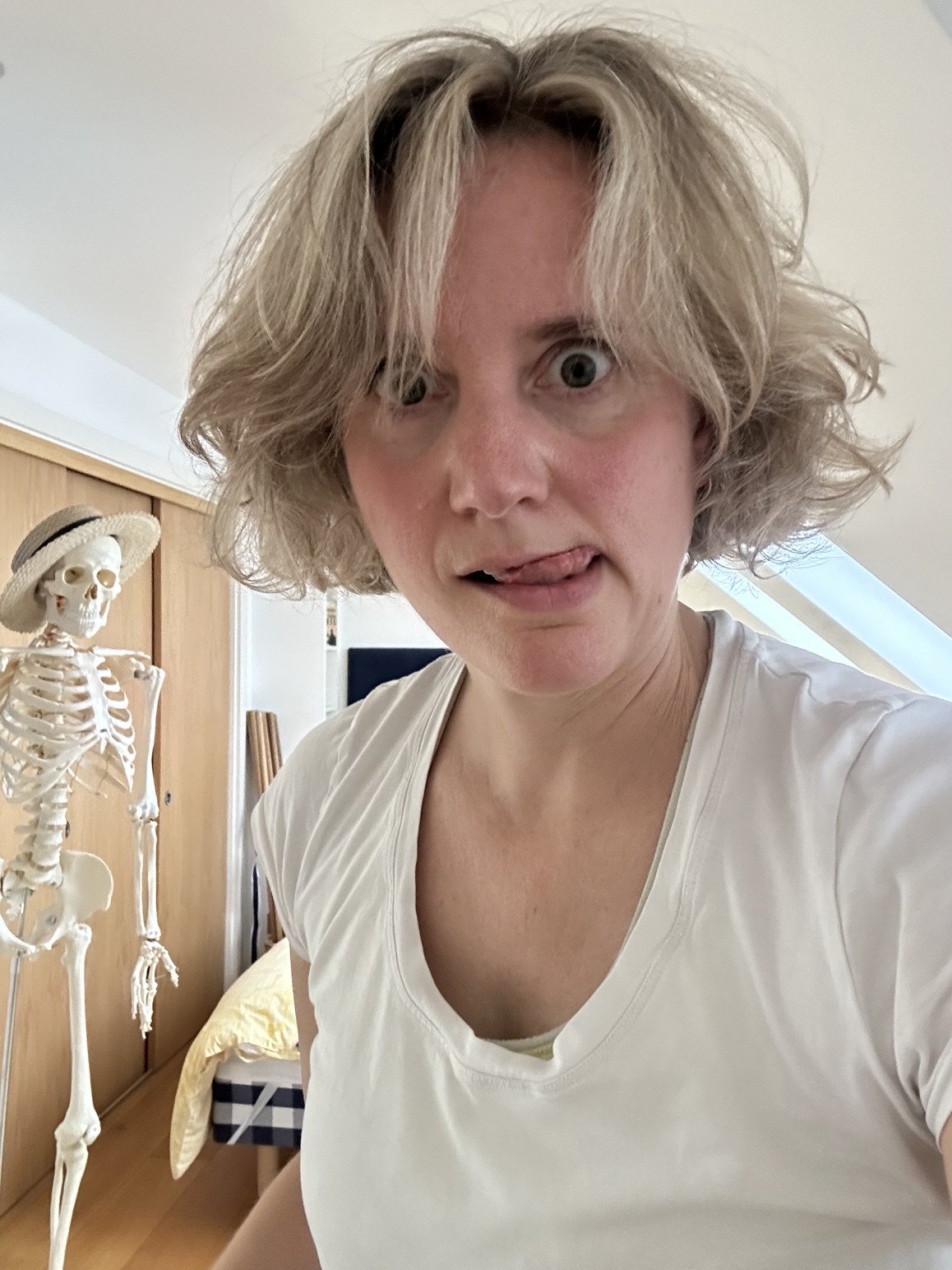
Candid selfie taken straight after the Conducted Performance.
Then a 45-minute conducted performance. This involves ‘performing’ the 39 poses given to us 15 minutes beforehand, which was almost the entire Level 2 syllabus. This was INTENSE. I had practiced this part of the assessment, but previous Level 2 assessments had had 27 poses so I had not done as many poses in one go before. However, I got into the rhythm of it, and the final Savasana felt pretty awesome.
Then a 10-minute personal presentation, which was prepared beforehand. This could be on any topic and the main prerequisite was that it should be inspiring. I did mine on the very personal topic of my personal practice during grief. I warned them that I might cry during the performance, and I did.
We were then given a slip of paper with three poses on it and a context. This was so that we could put together a sequence for the assessed 45-minute teaching session the next day. We could use any Level 1 or 2 pose along with the three poses given, but we also had to include Sirsasana (Headstand) and Sarvangasana (Shoulderstand).
We had already been given a time slot for our teaching session, and we went in one a time. There was a group of wonderful volunteers who did two 45-minute sessions before swapping over to the next group. I had the second teaching slot of the day at 10am, which felt like a good time to me.
The Teaching Bit
Level 2 is the first time you are assessed as a yoga teacher. This is something I do all day every day, so I should be good at this, but it’s not something I’d ever been assessed on.
As I drove to my mentor’s house that morning I had run through the sequence in my head, which I find helpful and calming. As I walked into the room I greeted everyone warmly. I made sure I got all the volunteers’ names first. I thanked them and told them not to be nervous, but to enjoy the class. I then started with sitting quietly in Sukhasana (easy crossed legs). This wasn’t a prerequisite of the teaching slot, and many candidates don’t do this, as it ‘wastes time’. But I felt that I needed it, and I guessed that the volunteers did too.
Then the teaching started. My mentor had messaged me the evening before with a reminder to not just focus on the physicality of the pose, but the sensitivity and breath. This is where Level 2 teaching differs from Level 1. You need to teach in detail, you need to observe each student in the pose, you need to encourage the students to ‘feel’ the pose in the body, not just ‘survive’ the pose. And to encourage sensitive use of the breath.
The class went by in a blur, and I have to say I enjoyed it. I didn’t have time to teach full Shoulderstand, so we did Brick Setubandha, but that was the only slight drawback.
The Result
After I taught my class there was nothing else to do but wait until around 3:45pm to get the result. I went for a coffee in Greenwich Park with a couple of the volunteer students (one of whom is a very good friend) to distract myself. Then we had lunch. At lunch the assessors inadvertently dropped a bombshell as they asked some volunteers to stay on.
This meant that one or more of us would need to do the dreaded ‘retakes’.
As part of the new system, candidates who were on the fence in terms of teaching would be offered a chance to ‘retake’, by teaching a pose again in front of the assessors. This is so that candidates could get their result that day, rather than waiting for a letter in the post.
This made the wait much more tense, and the tension only built as we were led upstairs to the studio. Unfortunately, it turned out that the other three candidates all needed to retake and I was the only one who had passed. To say I felt relieved is an understatement. But I also felt sad for the other candidates as I had bonded with them all having not met them before the weekend, and had been looking forward to celebrating together.
The Real Work Starts
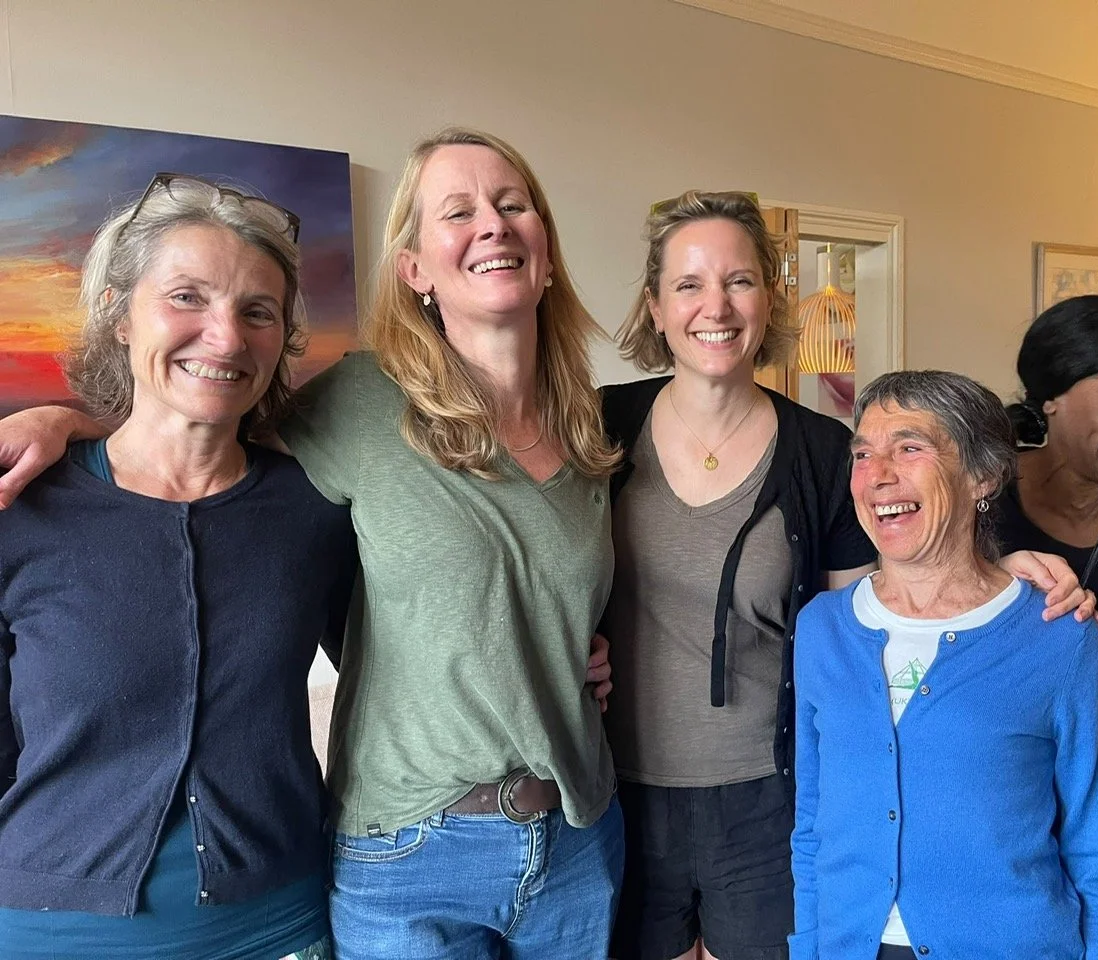
With all three of my regular teachers over the years - Cecilia Winter (current teacher), Amanda Richardson (first teacher) and Wendy Mcguire (longest teacher).
After I had passed I felt happy. It was lovely to hear that the assessors felt I was teaching naturally at Level 2, and I got some really good critical feedback too. It was lovely to let everyone know, to celebrate the hard work, and to share the joy with my mentors.
I messaged another senior teacher who told me, ‘Now the work begins’.
Just like a driving test, the driving you do for the test is very different from real life driving. It’s not as neat, it’s honed through hours of experience, and it changes.
Over the years I have practiced teaching the odd Level 2 pose to my students. Now I can interweave them through my classes. There are many challenging poses, and perhaps the final shape is unachievable to many of my students. So how do I teach them?
This is the joy of the Iyengar yoga teaching journey.
The day after I passed my Level 2 assessment I printed out the Level 3 pose list. I can ‘do’ roughly 50% of them. Onwards and upwards.